Off-Grid Solar in Victoria
Going Off-Grid in Southern Australia
A guide for resilient, reliable systems in Victoria, Southern NSW, Tasmania & South Australia
Living off-grid in Southern Australia — particularly in regions like South-East Victoria & Tasmania — brings both great rewards and significant energy challenges. From the dense fogs of Kinglake and the Dandenong Ranges to the bitterly cold, frosty winters in the valleys from Yea to Eildon, designing an off-grid system that works reliably year-round requires careful planning and a deep understanding of the local climate.
In this article, we’ll explore the key design considerations for off-grid systems in the Southern Australian climate, including passive building design, optimising winter solar performance, battery sizing, and how to future-proof your system for reliable year-round operation.
1. 🏡 Energy Efficiency & Passive Design Principles
Before considering an off-grid solar system, it’s essential to check whether your home is designed or retrofitted for optimal energy efficiency. Off-grid systems are sized based on your energy usage, and reducing energy consumption is much more cost-effective than adding more panels or batteries.
Insulation & sealing: High-quality wall and ceiling insulation, double glazing, and sealing gaps dramatically reduce heating and cooling demands.
Passive solar heating: The Orientation of your home and windows is key. North-facing windows can allow in winter sun for passive heating, especially when combined with thermal mass (e.g. concrete floors or internal brick walls).
Summer shading: Well-designed eaves or pergolas will block high summer sun while still allowing winter sunlight to warm your home.
Efficient appliances: Every watt counts. Choose low-consumption appliances, especially for major household loads such as refrigerators, hot water systems, heating, and cooling.
Try our free Off-grid Load Calculator to estimate your household loads.
2. ☀️ Winter Solar Challenges in Victoria
Southern and Central Victoria is known for its long, damp winters, particularly in forested regions like Kinglake, Healesville, Marysville and the Dandenong Ranges, where persistent fog, cloud cover, and low sunlight hours can significantly impact solar generation.
In these areas, solar energy production can drop to as little as 2 peak sun hours per day during June and July. To put this in simple terms, 2 peak sun hours means your solar panels only generate their full rated output for the equivalent of 2 hours per day, even if it's spread out across 8 hours. For example, an 8 kW solar array may produce at most around 16 kWh of energy on an average day, which is insufficient for most off-grid homes without a substantial battery or backup generator.
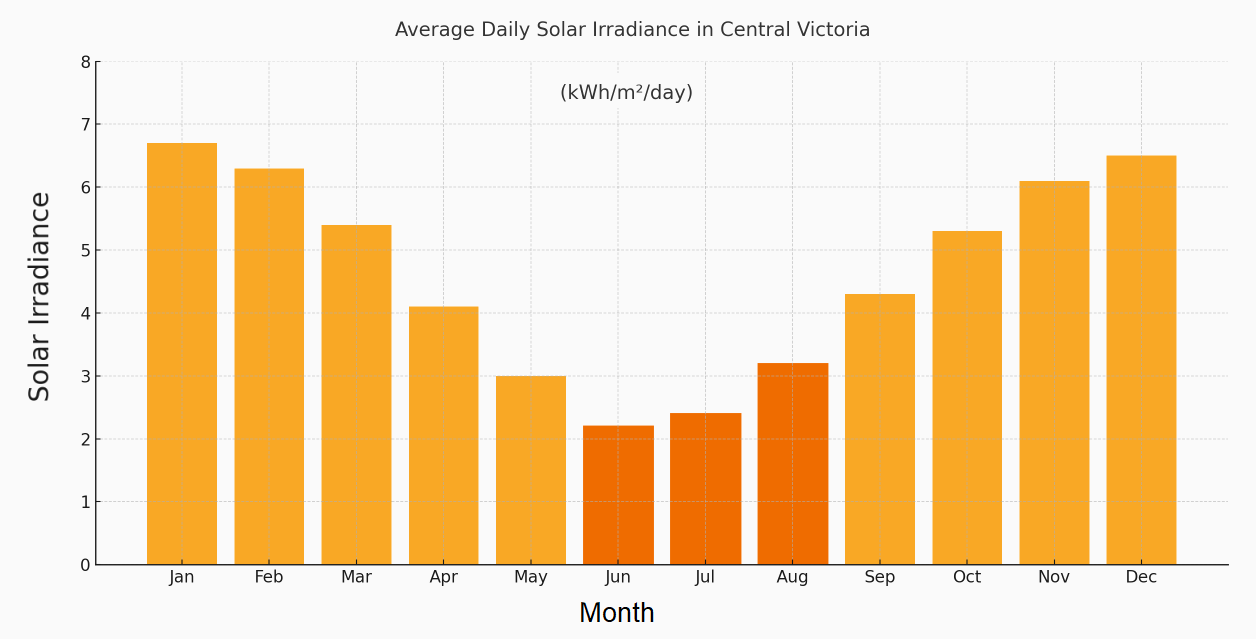
Due to this seasonal drop in sunlight, it's crucial to size your solar array for winter conditions, not summer. Oversizing the solar system ensures there's enough energy generation to meet demand during the coldest, darkest months — not just in June and July, but right through the shoulder seasons until late September, where sun hours are still low and heating demand can remain high.
To further enhance winter performance, we recommend installing solar arrays at a steeper tilt angle, typically between 30° and 45° facing North, depending on your roof pitch and site-specific conditions. This optimises the panels for the lower sun angle during winter and also helps prevent the build-up of leaves or dirt.
3. 🔋 Battery Sizing & Bad Weather Resilience
Modern lithium battery systems offer exceptional performance, but proper sizing is critical, especially in Victoria and Tasmania, where consecutive days of dark, foggy weather are common in winter. We typically recommend sizing batteries to provide at least two full days of autonomy (without solar), or more, depending on your tolerance for generator use. This often means:
20–40kWh of storage for small to mid-sized homes
40kWh+ for larger or more energy-hungry properties
Unlike older lead-acid systems, lithium batteries are modular and expandable, allowing you to grow your system over time as your energy needs change. They also support faster charging and deeper discharge cycles, which is ideal for dealing with the intermittent sunshine typical of Southern winters.
Use our off-grid size calculator to determine your optimum battery size.
4. ⚡ Inverter Sizing for Seasonal Loads
Heating in winter and cooling in summer are the two most demanding energy loads in an off-grid home. That’s why inverter sizing must be based on your peak winter and summer loads, not average use.
In winter, the inverter must be capable of running high-draw appliances, such as electric heaters or hydronic pumps, for extended periods of time.
In the summer, high ambient temperatures can lead to inverter thermal derating, where the output is automatically reduced to prevent overheating. This is why inverters need to be installed in adequately ventilated locations that do not face the hot afternoon sun.
Inverter Sizing and Location:
Oversizing the inverter slightly to handle seasonal peaks without strain.
Install inverters indoors or in well-ventilated enclosures.
Install battery systems in shaded, well-ventilated areas — ideally indoors or in weather-sealed enclosures.
Avoid locations prone to condensation, frost, or direct sun exposure.
This is especially important in hot inland areas, such as northern Victoria and South Australia, where inverter enclosures inside temperatures can exceed 50°C on hot summer days.
5. 🔄 Backup Generators & Battery Maintenance
Even the best-designed off-grid system needs a reliable backup power source — typically a petrol or diesel generator. We recommend systems that support automatic generator start for hands-free backup charging during extended periods of cloudiness or high winter loads.
Importantly, lithium battery systems must be fully charged at least every two weeks, particularly during winter, to maintain cell balancing and prolong battery health. If your solar system hasn’t topped off the batteries due to bad weather, the generator can complete battery charge cycle.
Regular battery charging to 100% helps:
Balance lithium cells internally
Reduce degradation
Prevent premature capacity loss
Expert Design for Local Conditions
At Transfer Solar, we specialise in designing and installing custom off-grid systems that work reliably in the toughest Southern Australian conditions.
With over a decade of experience in off-grid and hybrid solar systems, we understand the unique challenges posed by the damp hills around Healesville, the foggy winters of Kinglake, or the properties in the Dandenongs and Cathedral Ranges.
Our systems are designed from the ground up with:
Winter generation and heating loads in mind
Smart battery management and expandability
Weatherproof installation for long-term reliability
Generator integration for peace of mind
Ready to Go Off-Grid with Confidence?
Whether you’re building a new off-grid home or upgrading an older system, our team can help design a robust, efficient, and scalable power solution that works, even through the darkest days of winter.
👉 Contact Transfer Solar to discuss your ideal off-grid or battery system.